

You have crafted every screen of your application. The colors are yours, the tone is yours, every label speaks your users' language. And then the user clicks Sign in - and lands on a page that belongs to somebody else.
Identity-provider hosted login pages are a great default, but they are style-only brandable, they speak a fixed set of languages with no text overrides, and they will never quite feel like your product. A Bulgarian-language production application drove this point home for us: everything around sign-in could be built in-app, but the credential form itself could not.
Dirigible 14.30 closes that gap. Applications on the OAuth2 profiles can now own the sign-in experience end to end - the provider-hosted page simply never renders.
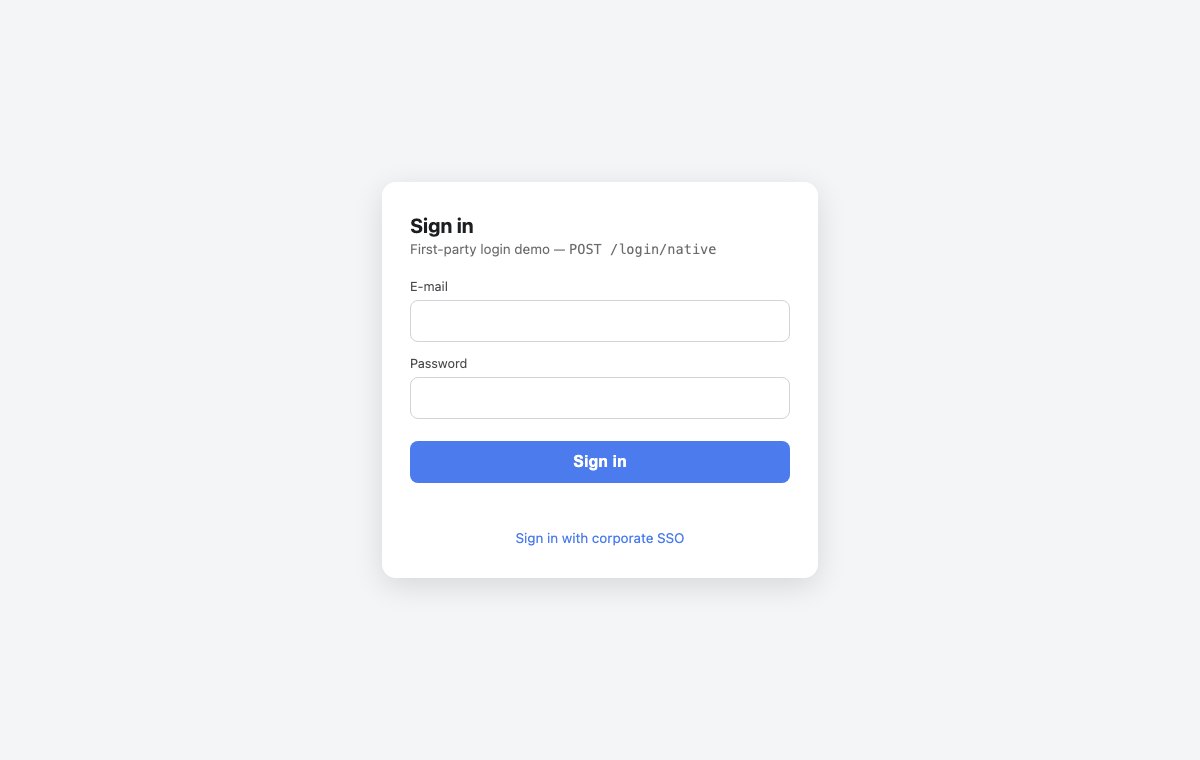
Native credential sign-in
The heart of the feature is one endpoint:
POST /login/native
Content-Type: application/json

{ "username": "jane.doe@example.org", "password": "..." }
The platform authenticates the credentials server-side against the identity provider and establishes the standard platform session - the same session the hosted flow creates, with the same principal, the same role mapping from the provider's groups, and the same provider-driven session re-validation. The browser receives only the session cookie; tokens never leave the server.
On the Cognito profile this runs over the SRP protocol (USER_SRP_AUTH): the password is used only to compute a zero-knowledge proof, so it never crosses the wire from the platform to AWS. No AWS SDK involved - pure JCA arithmetic against Cognito's published group parameters.
Multi-factor authentication is not an afterthought. When the provider requires another step - a TOTP code, an SMS code, a forced new password - the endpoint answers with a challenge, and the login page carries it through a simple round-trip:
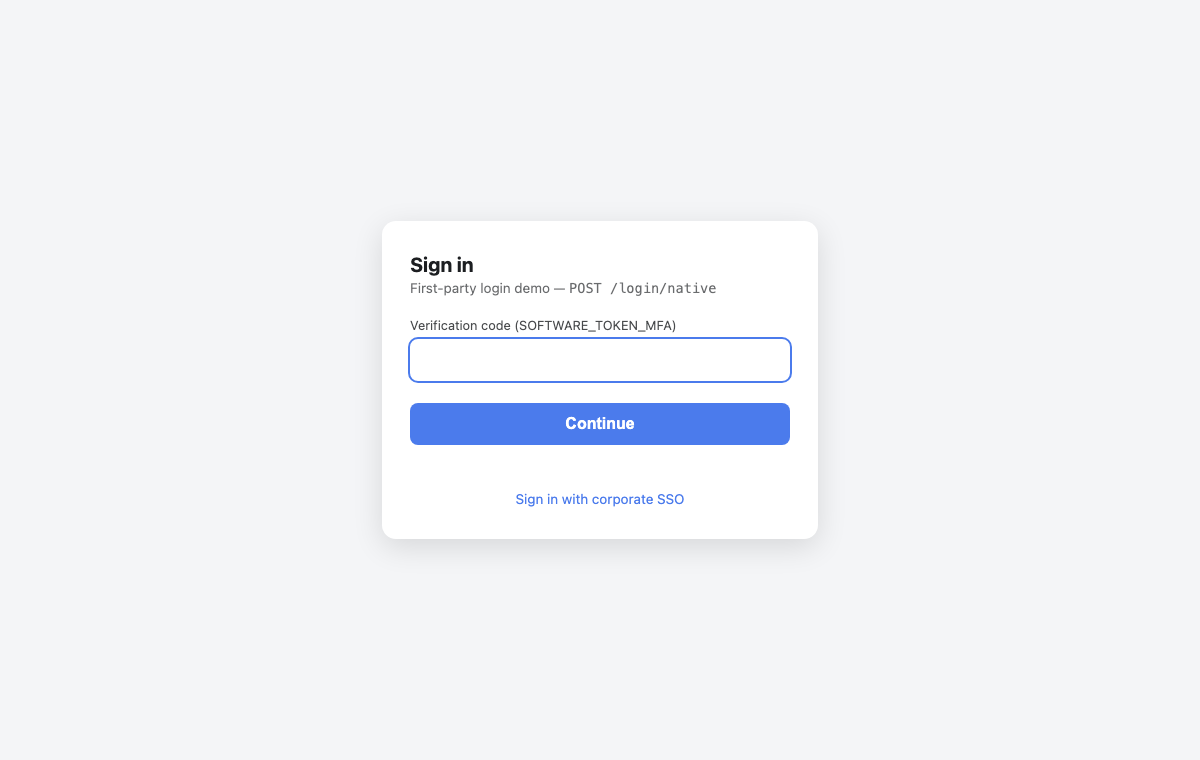
Failures come back as normalized outcome codes (INVALID_CREDENTIALS, PASSWORD_RESET_REQUIRED, TOO_MANY_ATTEMPTS, ...), never provider-raw messages - so the application decides the wording, in every language it supports.
One click to the corporate IdP
Federated users should not see a credential form at all. The authorization endpoint now forwards an allowlisted identity-provider hint, so a login page can deep-link straight to the corporate IdP:
<a href="/oauth2/authorization/cognito?identity_provider=CorporateSSO">
  Sign in with corporate SSO
</a>
One click, and the browser goes directly to the SAML or OIDC provider - Cognito's identity_provider and idp_identifier hints and Keycloak's kc_idp_hint are supported.
Your page at the front door
The last piece ties it together:
DIRIGIBLE_SECURITY_LOGIN_PAGE=/public/web/my-app/login.htmlUnauthenticated browsers now land on your page instead of the provider's. Unset, nothing changes - the feature is fully opt-in. And because the page is plain web content served by the platform, it works everywhere your application does:
Try it
- The reference login page - credential form, MFA round-trip, SSO deep link, in about a hundred lines of dependency-free HTML - lives at dirigiblelabs/sample-native-login.
- The documentation covers the endpoint contract, the outcome codes and the setup recipe: First-Party Sign-In.
- The feature ships with Eclipse Dirigible 14.30.
Your product, your language, your front door. Enjoy!